


The United Nations Office for Project Services (UNOPS)
Reducing plastic waste in Libya
UNOPS, UN-Habitat and Libya's Ministry of Local Government are working together to promote plastic waste reduction and recycling.
This article was originally published on 29 August 2024 and has been updated to reflect recent project developments.
Latest updates
December 2025
More than 600 volunteers have participated in public clean-up events, collecting around 9 tons of plastic and mixed waste, and awareness-raising campaigns have reached 2,750 students and 250 teachers in 17 schools.
Three municipalities and the Ministry of Local Government have participated in 15 capacity-building training sessions, resulting in improved technical understanding and coordination. A comprehensive action plan covering six groups – households, non-households, waste sorting and recycling, recovery facilities, disposal facilities, and civil society organizations/private sector – has also been developed.
Around 1,250 plastic waste collection bins have been procured and delivered to the Ministry of Local Government. The bins will be distributed to communities in the coming weeks to support the adoption of recycling.
November 2025
UNOPS and the Italian Agency for Development Cooperation (AICS) led field visits to observe plastic processing operations and to discuss current capacity and technical needs.
Four micro, small and medium-sized enterprises have been selected to receive grants for buying equipment to aid in plastic collection and recycling. They will receive technical guidance and assistance from UNOPS.
7 October 2024
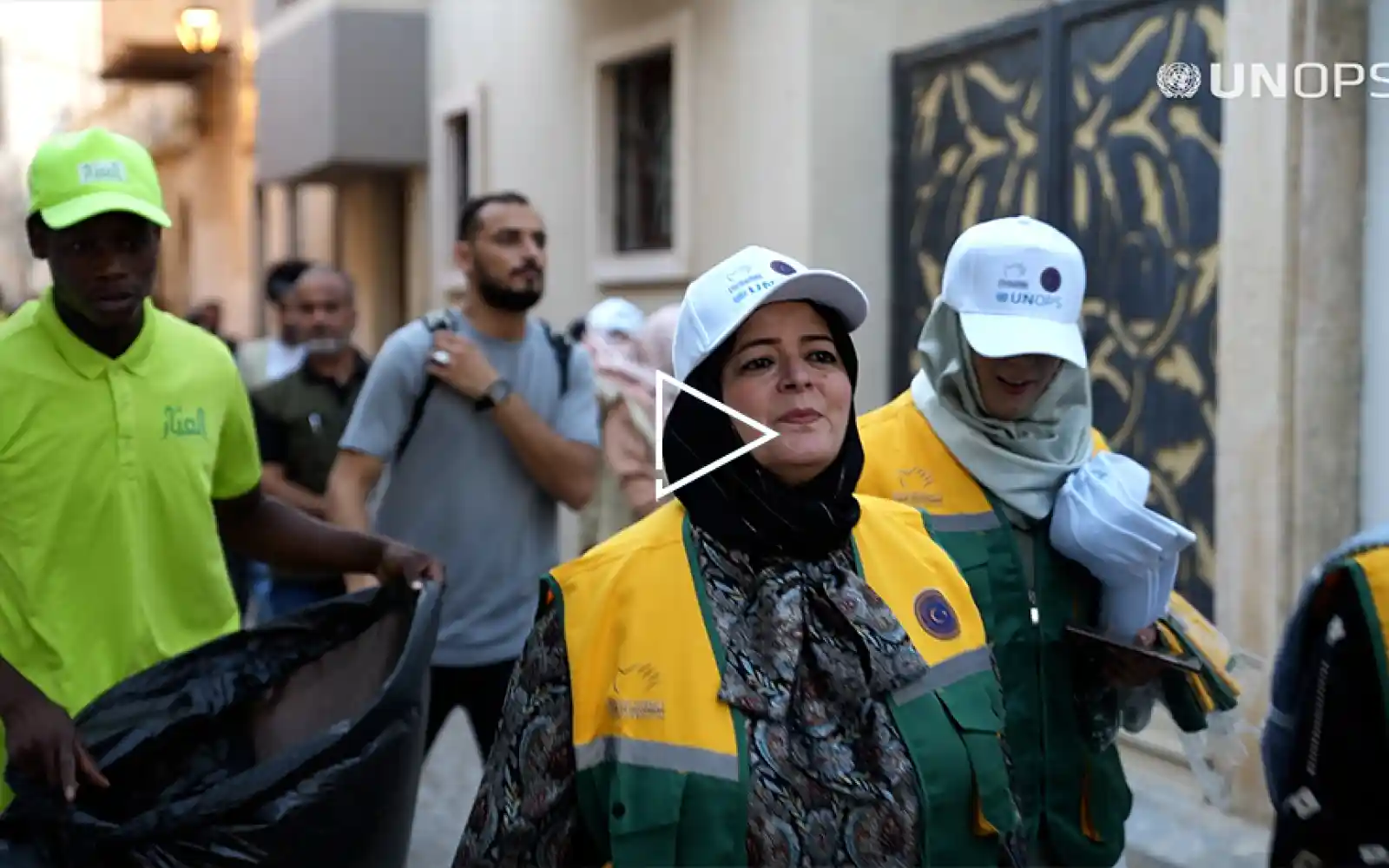
A clean-up day in Tripoli was recently organized, with local civil society organizations helping to raise awareness among children and youth about the impact of littering on their daily lives. The awareness campaign will be extended to selected schools in the city.
“Plastic recycling is also a driver for economic diversification and value creation – plastic waste must become a source of wealth and not a polluting agent, " said H.E. Gianluca Alberini, Italy's Ambassador to Libya.
Additional information available here (in Arabic)
Waste management is a major issue in several municipalities in Libya. And inadequate management of solid waste such as plastic can create conditions that negatively impact people's health and the environment.
A project funded by the Italian Agency for Development Cooperation will help decrease the amount of plastic waste generated in three municipalities in Libya: Abu-Salim, Souq Al Joum’aa and Tripoli Centre.
UNOPS is co-implementing the Italian Agency for Development Cooperation-funded €3 million project with UN-Habitat, in support of Libya's Ministry of Local Government.
The project will help improve the environment and living conditions while also opening up new avenues for economic opportunities by encouraging the recycling and reuse of plastic waste.
In collaboration with the Ministry of Local Government, UNOPS has provided comprehensive training to local civil society organizations that will implement awareness-raising and education campaigns on plastic waste management. The course equipped participants with the necessary tools and knowledge to effectively manage and promote plastic recycling efforts within their communities as well as provide information about plastic waste, the significance of recycling and its environmental impacts.
UNOPS will also provide training to local households to help reduce plastic waste generation at the community level. The campaigns and training will promote more responsible and eco-friendly behaviour in plastic use and disposal.
Employees from the Ministry of Local Government also attended the training to ensure it aligned with the government's broader objectives and to provide oversight and insight throughout the process.
A pilot programme will also encourage communities, private businesses and local authorities to promote the collection and recycling of high-quality plastic that can then be used to make new products.
As part of the pilot programme, UNOPS will also identify and procure equipment for micro-, small and medium-sized enterprises to collect, sort and recycle plastic as well as make products from recycled plastic. This will help encourage new economic and livelihood opportunities.
UNOPS and UN-Habitat will also work with municipal staff to explore innovative ways to collaborate with the private sector to ensure that the collection, sorting and recycling processes remain financially viable over the long term. Training will also be provided to the municipalities to improve sustainable plastic waste management.