



The United Nations Office for Project Services (UNOPS)
UNOPS 'As-Is' data
Enabling UN system-wide action
UNOPS provides implementation services for partners’ development, humanitarian and peacekeeping efforts. UNOPS was established as a self-financing UN organization by UN General Assembly decision 48/501 and began operating as a separate entity on 1 January 1995. Headquartered in Copenhagen, UNOPS marked its 30th anniversary in 2025, averaging annual delivery of nearly $3 billion USD over the past five years.
In 2010, UN General Assembly resolution 65/176 reaffirmed decisions on the UNOPS mandate and governance. In 2023, the Executive Board reaffirmed UNOPS mandate and position as a demand-driven, non-programmatic service provider. Its core role is implementation: delivering infrastructure, procurement and project management services complementing the broader UN system’s support of Member States and other partners. It is an agile resource for expanding partners’ implementation capacity, including in high-risk areas, providing impact through professional, accountable project execution of projects.
Focusing on delivery
Financially, UNOPS operates under a self-financing, pre-funded model, receiving contributions before implementation. In 2024, total project delivery amounted to around $2.7 billion USD.* This financial model underpins UNOPS operational agility while limiting reserve accumulation.
UNOPS is governed by the UNDP/UNFPA/UNOPS Executive Board, like other UN organizations supported by independent internal audit, investigations and ethics, and an audit advisory committee. Management ensures robust accountability and risk management, and maintains an external investment committee advising on financial status.
Implementation and management of projects are monitored against the strategic results framework, with results, transparent portfolio analysis and external thematic evaluations of impact reported to the Executive Board annually.
Collectively, these arrangements ensure the integrity of the unique UNOPS operating model, enabling its role as a specialized, operationally focused UN organization, positioned to translate financing and policy into tangible results for people through efficient, cost-effective, transparent and flexible implementation.
UNOPS comparative advantages:
Agile, efficient, cost-effective with global reach
Expertise in matching public and private partners for implementation of projects
Capacity to enable the implementation of global multilateral partnerships
Professional management of partners’ projects, programmes and portfolios guided by UN values
Global support services to UN partners in transactional services, such as human resources
Commitment to manage for impact and value for money
*In International Public Sector Accounting Standards (IPSAS) compliant audited financial statements reported as $1.48 billion USD of principal expense and $1.38 billion USD of agent expense. Assets totaled $3.8 billion USD, largely reflecting advances received by UNOPS for project delivery. Net equity was $374 million USD, and post-employment benefit liabilities are fully funded.
Expanding multilateral solutions
UNOPS accelerates implementation of the Sustainable Development Goals (SDGs), including climate action. UNOPS offers services through three models: support services, technical advice and integrated solutions combining both.
All UNOPS efforts are centered on the five mandated functional services: infrastructure, procurement, project management, human resources, and financial management – all delivered on a full cost-recovery, fee-for-service basis.*
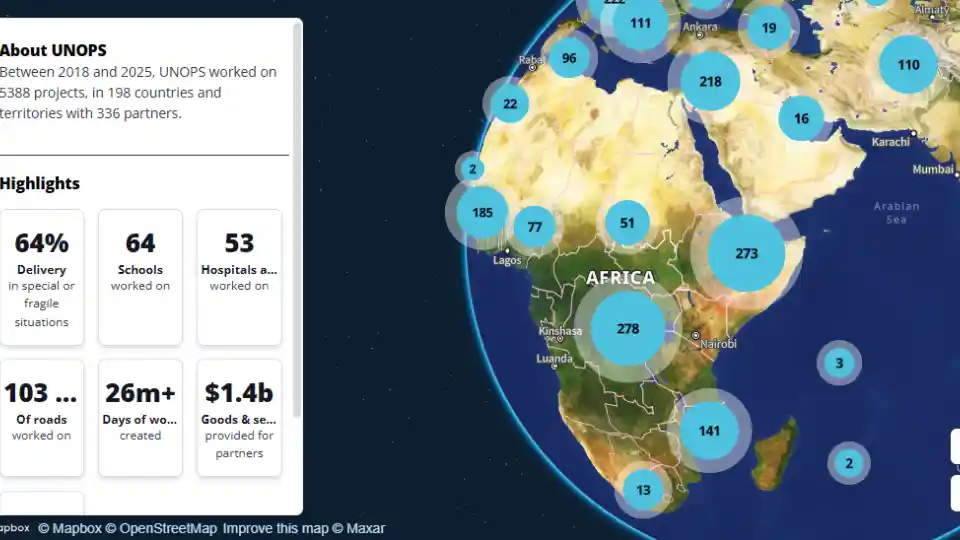
UNOPS implements over 1,100 projects across more than 130 countries annually on behalf of more than 200 partners.
In 2024, UNOPS procured $1.7 billion USD in goods and services from over 5,800 suppliers, managed $380 million USD in grants to implementing partners, and administered around 9,500 personnel contracts for partners in the UN.
UNOPS main partners include other UN entities, international financial institutions, donor and programme countries, vertical funds and multilateral initiatives.
UNOPS also provides hosting arrangements for 13 entities.
*The average cost recovery rate for 2026-2027 is capped at 5.3 per cent. In 2024, the actual management expense over project expense was 4.1 per cent.
Scaling to meet people’s needs
UNOPS maintains a globally distributed, project-based workforce on agile and scalable contract modalities. As of December 2025, UNOPS employed around 5,500 personnel worldwide, deployed across headquarters, regional offices, and multi-country and country offices. The UNOPS Global Shared Services Centre is a corporate delivery platform of transactional services internally and to partners.
Delivering where it matters most for people
The countries and different types of contexts in which UNOPS helps partners expand their implementation capacity to accelerate the SDGs illustrates the demand for UNOPS fee-for-service implementation, with demand growing every year.
Demand for UNOPS agile implementation remained particularly high in countries in special or fragile situations,* which accounted for 66 per cent of delivery, other countries accounted for 25 per cent, and nine per cent in a global portfolio delivered across multiple countries.
Project services delivered in response to demand from other UN entities remained stable at around 20 per cent of delivery. Other partners were 13 per cent for programme countries, 15 per cent for donor countries. Fifteen per cent was for vertical funds and multilateral initiatives and 29 per cent for international financial institutions. Finally, 6 per cent was for regional and other intergovernmental organizations and 2 per cent for other partners.
With marginal overheads, UNOPS operating model supports a broad range of partners’ accelerating the SDGs by bringing UN values to the marketplace for humanitarian, development and peacekeeping implementation, including in the most challenging contexts. UNOPS is a unique and agile UN resource.