



The United Nations Office for Project Services (UNOPS)
Statement to the First regular session of the Executive Board 2026
Statement by Jorge Moreira da Silva, UN Under-Secretary-General and UNOPS Executive Director, to UNDP/UNFPA/UNOPS Executive Board First regular session - 3 February 2026.
[As delivered]
Mr. President,
Distinguished Members of the Executive Board,
Colleagues,
It is an honour to address you today.
In addition to the colleagues on the podium, I also want to signal that in the room we have our General Council, the director of the Internal Audit and Investigation Group (IAIG), the Director of Ethics and also the Director of the Global Portfolios Office.
We gather at a moment of profound global turbulence and uncertainty. This is a moment of truth.
Daily realities for millions of people around the world are challenging shared values, commitments to peace, prosperity and development.
Needs are rapidly increasing as inequality, conflicts and crises deepen and spread.
Instead of more support for multilateralism and the work of the United Nations, there is the absolute dangerous opposite: dwindling, if not - in many cases- eroding support.
Our world is more violent than at any point since the second world war. We can see that in the forced displacement, the refugees, but also the number of people living under conflict. Twenty-five percent of the population today live in conflict-affected contexts.
Climate-related natural disasters are intensifying, with severe consequences for people’s lives and livelihoods around the world. Only in the past few months, we witnessed a trail of devastation from Hurricane Mellisa in Jamaica, cyclones and floods in south-east Asia, wildfires in California, and most recently floods in Mozambique.
Poverty continues to undermine human dignity, with one in ten people living in extreme poverty.
Progress towards reaching the Sustainable Development Goals - our commitment for a better future for all- is seriously off track.
Fragility does not come out of a vacuum. Food insecurity, natural disasters, economic crises combined are the perfect recipe for hindering progress.
Take for example the recent floods in Mozambique. They have devastated communities and increased disease and malnutrition risks, further straining conditions for a nation reeling from years of conflict.
These are not just figures, numbers, or at best news headlines.
These are people - mothers and fathers, children and older people - whose lives have been turned upside down, often overnight.
This Board knows well that words don’t feed hungry children, nor do they rebuild shattered communities.
It’s time for action: delivery at scale, timely results, practical and coordinated response that serves communities.
Yet, huge gaps remain between policy, finance and implementation. Development and climate funds continue to go to where it’s the easiest, and maybe not to those most in need. And even when funds and policies are in place - implementation lags.
So the urgent question for all of us is - are our current approaches to development working? I believe that we can do better. It is time to rethink and develop models that respond to the complexities of the seismic moment we face.
This is the spirit that guides the work of UNOPS including in our “Strategic Plan 2026-29” - endorsed by the Executive Board last year. We are determined to scale up and speed up impact through practical solutions. The lives of people hanging by a thread cannot wait.
And it is the spirit with which we embrace reforms and the UN80 initiative, so that together we can build a United Nations that delivers more effectively and more coherently. I insist on the point I’ve been making in the last few months: UN80 is not about adjusting the size of the UN to the support that is being provided. It is about adjusting the size of the UN and its capacity to respond at scale, consistent with the needs of the people.
Today, the UN is needed more than ever before, and here are a few examples on why.
***
UNOPS brings practical solutions to respond to needs, where they are the greatest.
UNOPS is dedicated to action. While we do not have a programmatic or policy mandate, we expand the implementation capacity of our partners.
Around the world, through our expertise in infrastructure, procurement and project management, we enable the work of our partners across development, humanitarian and peace efforts.
And this really matters: 92 percent of SDG targets depend on infrastructure. Between 15 to 20 percent of GDP in many countries is triggered by procurement. The ability to derisk investment and derisk implementation depends on project management. So an agency that is rooted in infrastructure, procurement and project management can play - and it is playing - a fundamental role to advance sustainable development, peace and security and humanitarian efforts.
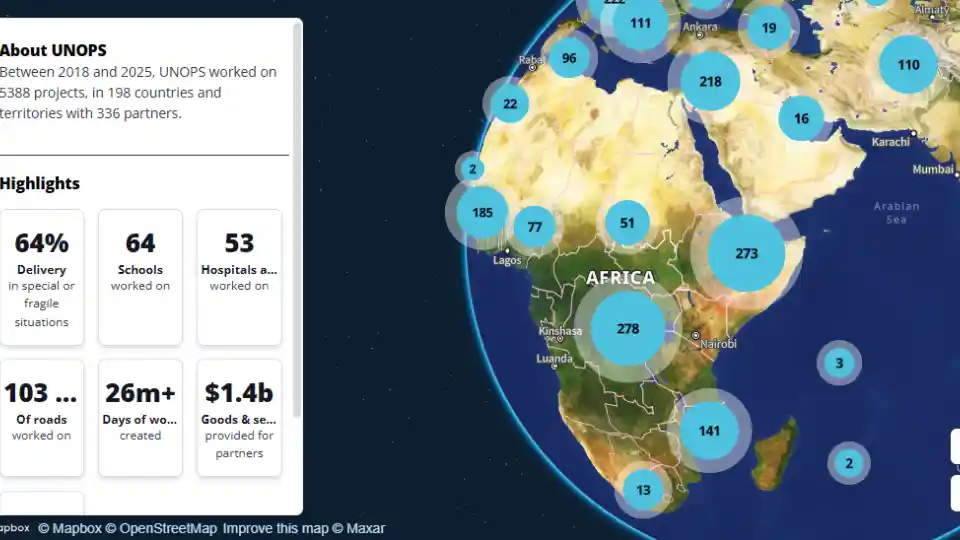
UNOPS enables the implementation of global multilateral partnerships, supporting over a dozen multilateral initiatives - working across a range of areas in health and nutrition, climate and energy, and sustainable development across 130+ countries and territories.
I am just mentioning a few examples. Stop TP, Roll Back Malaria, Cities Alliance, Sustainable Energy for All. These are just four examples out of 13 entities that are being hosted by UNOPS. Those entities are programmatic, we are non-programmatic but the fact that they were hosted by UNOPS enables them to operate. And this is a way to support what the Secretary General has called “networked multilateralism”.
UNOPS is about taking risks often on behalf of others: in a safe, transparent and effective manner.
We receive no core funding. We are fully self-financed through cost-recovery for projects we deliver on behalf of our partners. This means that for every project we implement, we agree upfront with our partners on delivery time, cost, and quality. Charging a minimum management fee to cover oversight and institutional costs at just over four per cent on average, this remains one of the lowest, if not the lowest, average fees across the UN.
The recent MOPAN (Multilateral Performance Network) review recognises that the business model of UNOPS is unique and demand-driven and the organisation makes efficiency and performance a necessity, not a luxury.
***
Allow me to share a few examples of the work that UNOPS does, with your support, with partners to bring impact for communities.
In Ukraine, where relentless attacks on civilian infrastructure -as we witnessed yesterday evening- continue against the backdrop of extreme cold weather, leaving thousands without electricity, heating and water, we continue to work with partners to restore basic services. We have purchased and delivered over US$ 45 million worth of heating equipment last year, helping municipal workers keep the heating on for hundreds of thousands of families in conflict-affected regions. Last month, our EU-funded school repairs project completed repairs at 21 war-damaged schools in the north eastern Kharkiv region, allowing in-person classes to resume for thousands of children. And the same has happened in previous projects that I have mentioned in the Mykolaiv region, on the rehabilitation of neighbourhoods.
In parallel, my colleagues in the war-torn country work hard to support communities with water towers, school buses, firefighting equipment, demining solutions and medical supplies.
In the Gaza Strip, we provide critical operational support to humanitarian partners. Procuring, delivering and distributing fuel for humanitarian operations, running the UN2720 Mechanism to facilitate, streamline and accelerate the delivery of aid, supporting explosive threat management together with UNMAS, emergency procurement, and facilitating aid personnel movement in and out of Gaza . These are just a few examples of the work that UNOPS has been doing in Gaza.
I have just returned from my third visit to Gaza since the war began. The scale of devastation is unimaginable. The people of Gaza need every ounce of our support as they recover and overcome destruction and trauma. And let’s make no mistake: while reconstruction and long term development is fundamental, we can’t wait, we can’t procrastinate. We must bring immediate relief to the people now; we can’t wait six months or a year for reconstruction. We need to provide early recovery in Gaza. And I had the chance to discuss with many of you in the last few days some concrete solutions that UNOPS is ready to provide, to support early recovery in Gaza.
In Myanmar, we work with partners to improve health, livelihoods, rural development and agriculture. UNOPS manages some of the largest development projects in livelihoods, health and food security. My colleagues in Myanmar also support humanitarian efforts to reduce the risk posed by mines.
In Sierra Leone, we continue our work to expand access to sustainable energy in communities across the country, together with the government and several partners, namely the European Union and Sustainable Energy for All.
And in Afghanistan, which is becoming almost a semi-forgotten crisis, we work with our partners and communities to address urgent needs and create livelihood opportunities. One example is the Afghanistan Community Resilience and Livelihoods Project, funded by the World Bank and the Afghanistan Resilience Trust Fund, which has so far improved access to essential services for over 15 million people, half of them women. Most of this is done through a cash-for-work programme, providing small income to communities. And I had the chance on the ground to see how this project is being developed, relying completely on people’s legitimate aspirations, which shows that it is possible to directly serve and support the people.
In another example, UNOPS Compass, our latest smart digital product, uses geospatial technology and an AI-powered platform to support decision-making in conflict, disaster, and development contexts. It is enabled by satellite imagery, data analytics, and information management systems, and turns complex data into actionable insights, helping response teams make better decisions in challenging environments. And we are using this already in several regions.
This is just a drop in the ocean - a few examples of the work of UNOPS in over 130 countries.
Needless to say that all of this great work would not have been possible without the support and commitment of our partners. And I want to again thank Member States in this Executive Board, but also other partners for the support to the people on the ground through UNOPS. So, it’s not about supporting UNOPS - it’s about supporting people through UNOPS.
For 30 years, we have worked with a wide range of partners: The United Nations, governments, intergovernmental, international and regional financial institutions, vertical funds, the private sector and NGOs.
According to our latest survey, partners trust UNOPS, commend our response and value the effective and unique model of how we work. We would be very glad to share the results of this Partner Survey. Yesterday I mentioned that 85 percent of our partners expressed satisfaction with our work and this is an improvement from previous years.
Over the past three decades, UNOPS delivery has grown nearly eight times. As we marked our 30th birthday last year, the average annual delivery has been 3 billion every year and that’s only through just over 5,500 people working around the clock to deliver results.
As I mentioned, we charge one of the lowest average fees across the UN. This same fee covers all our institutional costs. All costs are covered by this fee, distinguishing our operating model from other models that are based on core, unearmarked or voluntary contributions. That’s why I’ve been making the case for a fee for service model - not making the case for UNOPS. I’ve been making the case that fee for service is a very effective model to support projects on the ground.
This is a model worth replicating especially amid funding cuts and other key challenges to the UN and the aid and development sector. UNOPS is a flexible organisation. It scales up and scales down on demand - and is only present in locations where we have projects, reducing costs, but maintaining impact.
But let’s not confuse residence with presence. And let’s not confuse visibility with impact. And I would like to give you two examples, in the context of UN80, about what “relevance”, “impact” and “presence” mean.
When Hurricane Melissa hit Jamaica, as I mentioned before, in 24 hours we were asked by the Prime Minister and the Resident Coordinator to provide support to Jamaica. How could we do it? Because we were in the region and could provide surge capacity from the region to Jamaica.
But let me also cite another example from the other extreme. In Myanmar, when we had the earthquake in Mandalay, we were the agency that was asked to provide quick support. Why? because we were and we are the largest agency in Myanmar. Because it is so difficult to bring surge support to Myanmar in the context of that country, it was easier to use an agency that was already there to shift some of the work that we were doing. We agreed with the partners - in this case the Global Fund - and we immediately reprofiled our support to help the people affected by the earthquake.
So you can see in these two examples, that in one case being present matters. The residence matters, because you have the capacity to quickly provide surge support. But in the other case - you don’t need to be present- you just need to be ready.
This is the kind of conversation that we need in the context of UN80 - turning the reconfiguration of country teams into a real opportunity to delink relevance from residence and insuring that we have more capacity to deliver on the ground but not an obligatory need to have all agencies present exactly in the same places.
Mr President I know that this is not the topic for today but somehow everything is about UN80 so I brought this element into the discussion. Particularly as you know because I have been under the Deputy Secretary-General’s guidance leading the workstream on the reconfiguration of country teams.
Going back to UNOPS - our teams are the backbone of this organization, and I really want to pay tribute to the outstanding work that they have been doing, both the colleagues on the ground but also those in headquarters enabling others that are on the ground to deliver in an agile and flexible manner. Their commitment, flexibility and passion to serve, are what enable us to deliver in some of the most challenging environments in the world. Strengthening our organisational culture - as you have heard on many occasions from my colleague Valerie Kushata - the Director of People and Culture Group - has therefore been a central part of our reform agenda over the past three years.
The results from the 2025 Culture and Engagement Survey show encouraging progress. A clear momentum in culture transformation. We see better results now which means that reforms are delivering results. Engagement and overall satisfaction continue to improve, with an increase in trust in leadership at the local level, transparency, communication and psychological safety, echoed in personnel feedback. I am mentioning this because I have on many occasions heard Member States asking how the staff are and how their morale is. Asking us how “how are you doing despite the challenges”. I think that the good news is that with your support during this rescue phase over the last three years, we have planted the seeds for better results on culture and engagement and now we are seeing such results.
Underpinning all these efforts is our continuous commitment to reforms at UNOPS. Let me provide some context here.
Following the crisis in 2022 - UNOPS embarked on a far-reaching reform journey to strengthen governance, accountability and organisational resilience. This included reinforced risk management and internal controls, clearer lines of responsibility and oversight, strengthened ethics and compliance functions, and a renewed focus on organisational culture. At the same time, UNOPS has advanced reforms in planning, performance management and transparency, embedding a stronger results-based and impact-oriented approach aligned with our operational mandate.
Last year- as you know - we completed the Comprehensive Response Plan (CRP), with the exception of the Process Innovation and Digitalization (PID). But also as I outlined at the time, one thing is approving the reforms, the other thing is ensuring that those reforms are sustained, monitored and getting the impact. No complacency is allowed. I want to reiterate that we continue to be committed to ensure that even if the program is concluded, the content of the program is duly monitored to ensure that it's well-implemented, and that if needed we course correct.
Our reforms however go beyond the recommendations in the CRP. Our objective is clear: to emerge stronger, with systems, culture and governance fit for a complex and high-risk delivery environment. Let’s not forget that UNOPS works in high-risk environments and this also makes this organization different from others. An organization with seventy percent of its activities concentrated in [special and ] fragile contexts, and almost half in conflict-affected contexts. Obviously we operate in high-risk delivery environments. But that is crucial to support people.
These reforms beyond the CRP are ongoing. And my colleagues Karl Ludwig Soll, the Chief Financial Officer and Hillary Balbuena, the Chief of Staff, who is also the Chief Transformations Officer will provide the latest updates on our PID programme and our broader transformation initiatives. The director of PID is also on the podium.
I wish to take this opportunity to emphasise the strength of our independent internal oversight functions. I assure you that UNOPS structures are in accordance with United Nations Standards. I am confident that UNOPS has robust integrity and accountability systems in place.
For reforms to deliver lasting impact and tangible results, we need your support.
Investing in our systems and the organisation’s capacity to deliver is key.
And when you talk about strengthening the systems that are needed, there are only two ways to address it:
a. One is to increase the cost of our services - placing an unfair burden on our partners at a time of dwindling resources, I think that nobody is a good idea to increase the management fee to address our needs to strengthen our systems
or
b. Alternatively to allow us to use the reserves to advance namely the Process Innovation and Digitalization programme.
Our partners need us to deliver fast, effectively and at scale on the ground.
As the leader of UNOPS - and I think you need to hear this from me because it is an oversight function- as the CEO of the organization, I need to be in a position - as I am accountable to Member States- to invest in our expertise and capacity to deliver.
Several members have already raised questions about the continuation of the temporary measures introduced with the Comprehensive Response Plan. In many bilaterals and several meetings, Member States are asking, do we want to continue with these temporary measures introduced at the CRP. These measures limit my ability to approve continued institutional investments in the organization and I stand ready to discuss this with Member States. You will decide what is the best moment to have this discussion Mr President. Probably in time for the next session.
But indeed the point that Member States have been making makes sense. I have not been taking these initiatives. It's the Member States that have approached us asking do you think we should continue with those temporary measures or do you need something else to ensure that you have the capacity to invest in your systems to deliver better. I am totally open of course to engage with Member States on this discussion.
Let me conclude
We are no stranger to reforms.
As an organisation, continuous learning and adaptation is in our DNA. We welcome the assessment on the work of UNOPS and UNDP to promote and achieve sustainable development at this time of grave need, globally.
We will build on learning from our reforms as we work together with the UN and member states to make UN80 meaningful with a focus on tangible results. And we stand ready to build on what works: Preserving and advancing the fee for service model offers a possible pathway for our collective efforts to reform the development system.
In a world marked by growing uncertainty and complexity, our collective challenge is clear: to adapt, stay focused, and deliver better.
We remain committed to turning ambition into action - with integrity, accountability and results at the centre of the work we do.
With your guidance, we will continue strengthening our organisation and contribute to reforms that enable the United Nations to deliver more effectively where it matters most.
This is the minimum we can do for the people we serve. They need and merit a fairer, greener, more peaceful future, and they need a stronger United Nations.
Media enquiries
For more information please contact:
Juliette Touma, UNOPS Global Director of Communications, +45 53 52 01 27, juliettet@unops.org