

The United Nations Office for Project Services (UNOPS)
UN Day remarks by UNOPS Executive Director Jorge Moreira da Silva
Remarks by UN Under-Secretary-General and UNOPS Executive Director Jorge Moreira da Silva at the UN Day event held at UN City Copenhagen, 21 October 2026.
[Check against delivery]
Minister Rasmussen, Excellencies, colleagues,
Welcome to today’s townhall.
On behalf of UN City - Minister Rasmussen, we thank the government of Denmark for joining us today on such an important occasion - and for Denmark’s support for UN City and multilateralism.
This is a powerful moment to remind ourselves why we are here, and our shared commitment to the UN charter.
Eighty one years since the United Nations was founded- our world has changed profoundly. We find ourselves at a perilous moment marked by uncertainty and the erosion of trust.
Today, multilateralism faces a difficult test. Conflicts are multiplying. Climate impacts are intensifying. And just as needs are growing, the resources available to address them are shrinking. Official development assistance fell by more than 23 per cent in 2025, with further declines projected.
Meanwhile, the UN is expected to deliver more, for more people, with far fewer resources.
This is the context in which we must understand the UN80 reforms. Getting fit to deliver at scale.
I have been heavily involved in its aspects - including coordinating the reform on the reconfiguration of UN country teams - and I know that many colleagues in this building too have contributed significantly to different work packages.
That reconfiguration of country teams is now in its implementation phase - and the task ahead of us is to turn commitments into results that people can see: a more coherent United Nations, less duplication, better use of resources, stronger cooperation and greater impact on the ground for the communities we are serving.
As United Nations employees - we are a dedicated and driven group of people. The journey has been far from easy. In the last couple years, hundreds of UN staff lost their lives in Gaza and in other conflict zones. Many colleagues around this building have seen friends being relocated - or even lose their jobs. And many have experienced uncertainty. That’s why I want to thank and praise all colleagues for their passion for multilateralism, their passion for the UN and especially their restless commitment in getting the job done serving those who need it most.
Ultimately, these reforms will be judged by the difference we make in the lives of people around the world. The bottom line is, the UN must continue to reform to be fit for purpose, more agile and responsive in the face of today’s challenges.
***
We are in Copenhagen but let’s not forget that our focus is, from here, to enable colleagues on the ground to support the people in need, especially in a context where development and climate are truly interdependent.
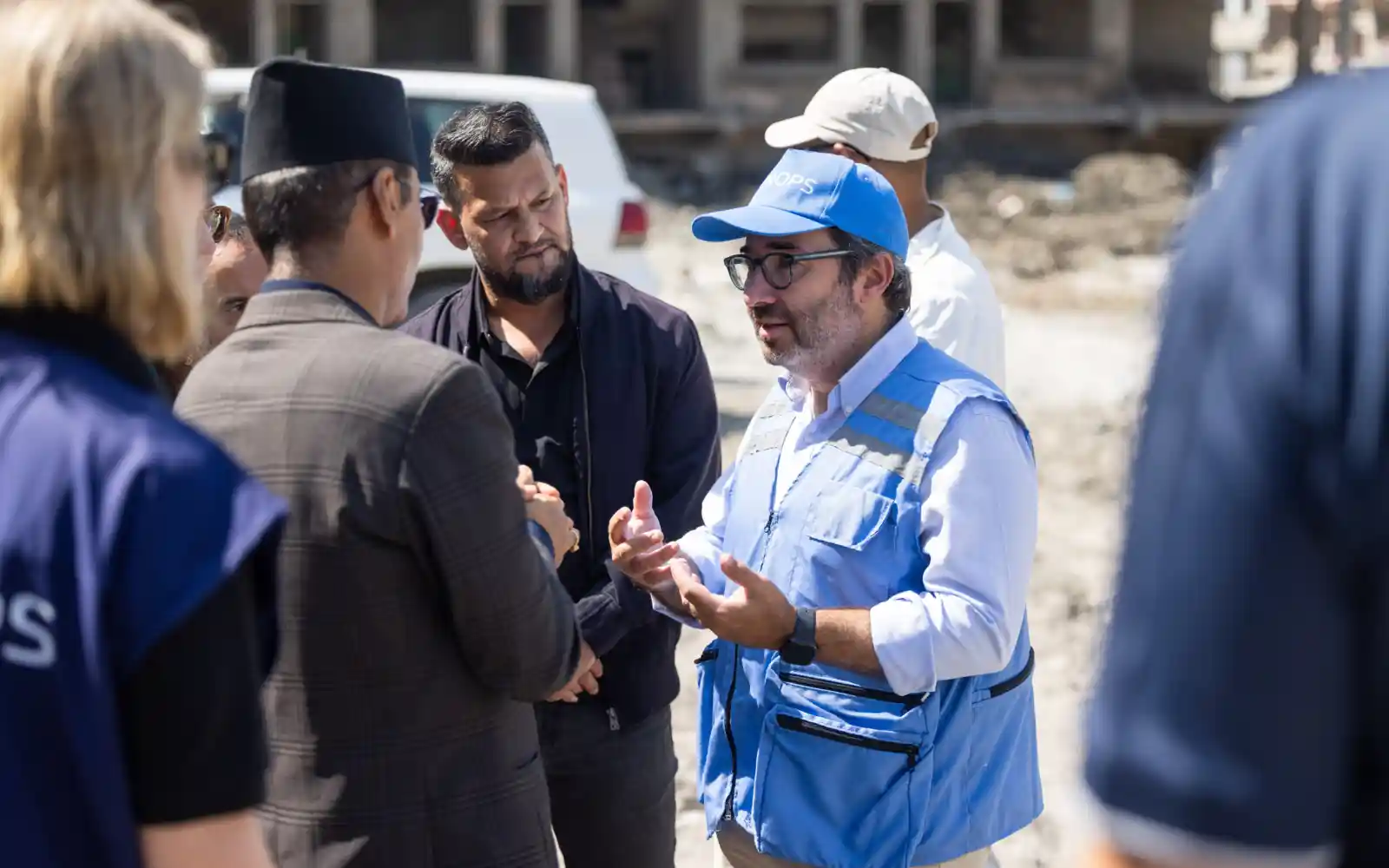
I have just returned from Asia, where these challenges are very tangible. In Nepal, I visited communities in Rasuwa and Nuwakot that had lost loved ones, homes, entire livelihoods and their critical infrastructure in the flash floods caused by glacier outburst last August. And floods still continue - even if they don’t make it to the news anymore.
More than 1,500 people lost their lives. Over 5,600 people are still missing. Survivors told me that, in a matter of seconds, they were flooded by a massive water wall of 100m high, travelling at a speed of 180 km/h. The World Bank estimates US$4.8 billion is needed for reconstruction.
People in Nepal are paying the price for a climate crisis not of their making. They emit just 0.08% of global GHG and they then have to bear the brunt and try to deal with its worst consequences. Recovery and reconstruction is made all the more difficult by the energy and food security crisis triggered by the disruption on the Strait of Hormuz, followed by disruption in the Black Sea and Red Sea.
The impacts extend far beyond Nepal: the Hindu Kush Himalaya is a vital source of water for over 2 billion people - around a quarter of humanity. But the region is warming about twice as fast as the global average.
This is one example of the interconnected and multidimensional challenges facing communities globally, challenges that demand new ways of working and stronger cooperation to be able to respond effectively. We must align all climate action with development and align all development with climate action. This is the moment of truth, as the SG used to say.
That’s why we can’t waste time. Rather than procrastination, it is time to double down on SDGs and the Paris Agreement.
And this brings me back to Copenhagen - and the solutions we can develop here together.
****
UN City is a remarkable hub of United Nations expertise.
We are fortunate that our host Denmark and its Nordic neighbours have a strong tradition of supporting multilateralism, sustainable development and international cooperation.
Nordic countries also bring expertise in innovation, green transition and digital solutions that can help address some of the world's most pressing challenges.
Our opportunity is to turn that proximity into partnerships - and strengthen our contribution from Copenhagen. So we can connect our respective capabilities to deliver better results, reduce fragmentation and make every penny used efficiently and effectively.
Let us build on these strengths, deepening our partnerships with governments, research institutions and the private sector, and connecting Nordic innovation with the UN’s global reach and operational capabilities.
At a time when multilateralism is under pressure, we must demonstrate its practical value.
From Copenhagen - we can show that multilateral solutions really can deliver a tangible difference to people’s lives.
This UN Day let’s commit to make that ambition a reality.