


The United Nations Office for Project Services (UNOPS)
Sustainable Infrastructure in the CEI Region
Remarks by Jorge Moreira da Silva, UN Under-Secretary-General and UNOPS Executive Director, at panel discussion 'Sustainable infrastructure in the Central European Initiative (CEI) region: Regional cooperation as a driver for SDG implementation', UN High-Level Political Forum, 13 July 2026.
[Check against delivery]
Ambassadors, colleagues, dear delegates,
I am delighted to join you today.
Infrastructure is at the heart of sustainable development and central to climate action. According to UNOPS research, infrastructure influences more than 90 per cent of the Sustainable Development Goals (SDGs), and accounts for nearly 80 per cent of global greenhouse gas emissions. The infrastructure choices the world is making today will shape development and climate outcomes for decades to come, impacting the children of today and tomorrow’s generations.
What pops to mind when infrastructure is mentioned is likely roads, bridges, railways or energy networks. Infrastructure, however, is much more than physical assets. It is what connects people around the world to jobs, markets, education, healthcare and opportunity. It enables economies to grow, communities to withstand shocks, and societies to remain linked especially in times of uncertainty.
In today’s charged and uncertain geopolitical environment – making the right infrastructure investments is critical to support communities and a key for stability and regional cooperation and connectivity.
This is particularly true of the Central European Initiative (CEI) region. As the region continues to strengthen economic integration and advance towards the SDGs, infrastructure has an essential role to play in narrowing development gaps, supporting EU accession processes and strengthening resilience of systems to climate change and other emerging risks including natural disasters and conflicts.
Governments across the region have developed strategies. They are seeking innovative financial resources and drawing up investment plans. The challenge is in implementation, turning strategies into actions and tangible results for communities. Delivering infrastructure at EU standards requires strong institutions, efficient procurement, project management, transparency and local ownership.
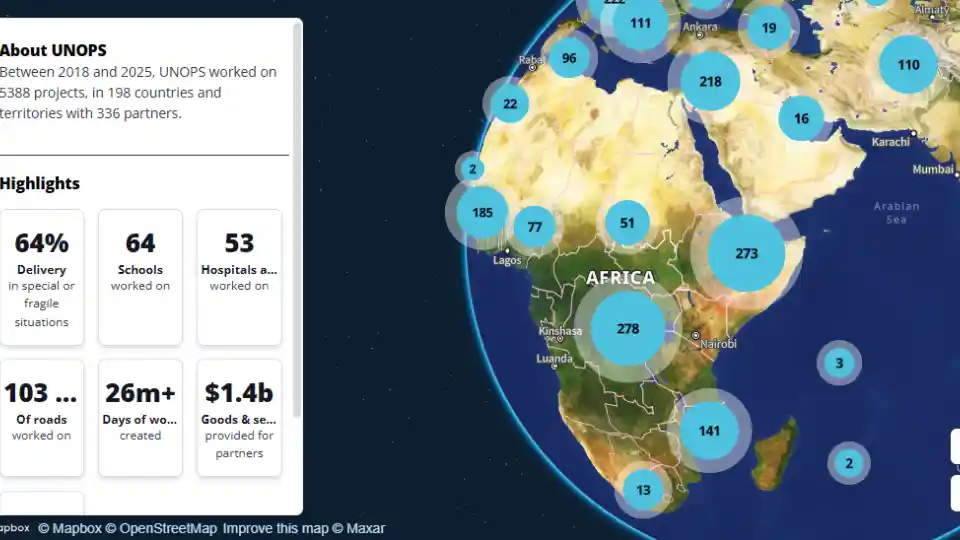
At the heart of its mandate, UNOPS has implementation. The agency provides practical solutions across infrastructure, procurement and project management services to partners across 130 countries. And that includes Team Europe and our partners in Central, Eastern and South-Eastern Europe, and the Eastern neighbourhood.
We work with a range of partners, governments, international financial institutions, private sector, the UN system and civil society, to deliver projects that make a tangible improvement to people’s lives.
Across the region - we are putting this approach to practice.
In Ukraine, UNOPS has been supporting the country's response and recovery over the past four years. As recovery increasingly shifts from humanitarian assistance to government-led investment, our role is evolving from emergency delivery towards enabling implementation at scale. Working alongside national and local authorities, we help translate investment into practical results across healthcare, education, housing, energy resilience and mine action. UNOPS is restoring critical civilian infrastructure and also strengthening the institutional and implementation capacity needed for Ukraine's long-term recovery.
In Albania, UNOPS implemented a programme funded by the EU - called EU4Culture - to restore cultural heritage damaged by the 2019 earthquake. The programme went far beyond restoration. It helped revitalise local economies, support tourism, strengthen national institutions and preserve cultural identity. Last month, the UN Deputy Secretary-General Amina Mohammed referred to EU4Culture as an innovative approach to supporting the SDGs by building resilient communities.
Strengthening digital infrastructure is another key focus. In Albania and Montenegro, UNOPS is partnering with the governments to strengthen IT infrastructure and drive digitisation of the rule of law sector.
In Montenegro and Kosovo, UNOPS is helping enhance education infrastructure, making it inclusive, accessible, modern and energy efficient.
And in Serbia, we work with the EU and national and local authorities to build homes for vulnerable families and enhance their social inclusion. Through this work, we have provided accommodation, jobs and social, education and healthcare facilities to Roma communities, disadvantaged women (in particular survivors of domestic violence), youth in foster care, and people with disabilities.
Across all of these examples - there is one common theme.
Sustainable infrastructure goes beyond the brick and stone. It brings people together, creates safe spaces for communities to reconnect and thrive.
At UNOPS, we strongly support the EU’s notion of territorial development that is key for the implementation of the EU Cohesion Policies, to drive balanced growth across all European regions so that development is supported by adequate infrastructure at municipal level.
Colleagues,
In the face of today’s multiple and compounding challenges - from geopolitical uncertainty including armed conflicts, disruptions in supply chains and a rapid erosion of global values, to the ever worsening climate crises (including in Europe with the recent wild fires) - no single institution can succeed alone.
Governments, the European Union, regional organisations, international financial institutions, the private sector and the United Nations all and together can and should bring solutions and results. Collectively, we can combine strategic vision with implementation, align investments with national priorities for infrastructure that delivers lasting value for the communities.
At UNOPS, we will continue partnering with countries across the CEI region, bringing our implementation capacity through our teams in-country - to translate national and regional ambitions into results for communities.
Thank you.