




The United Nations Office for Project Services (UNOPS)
FOR IMMEDIATE RELEASE
UN spent nearly $23 billion on goods and services in 2025
COPENHAGEN 7 JULY 2026 | UN organizations spent $22.7 billion on goods and services in 2025, according to a new report published by UNOPS on behalf of the UN system.
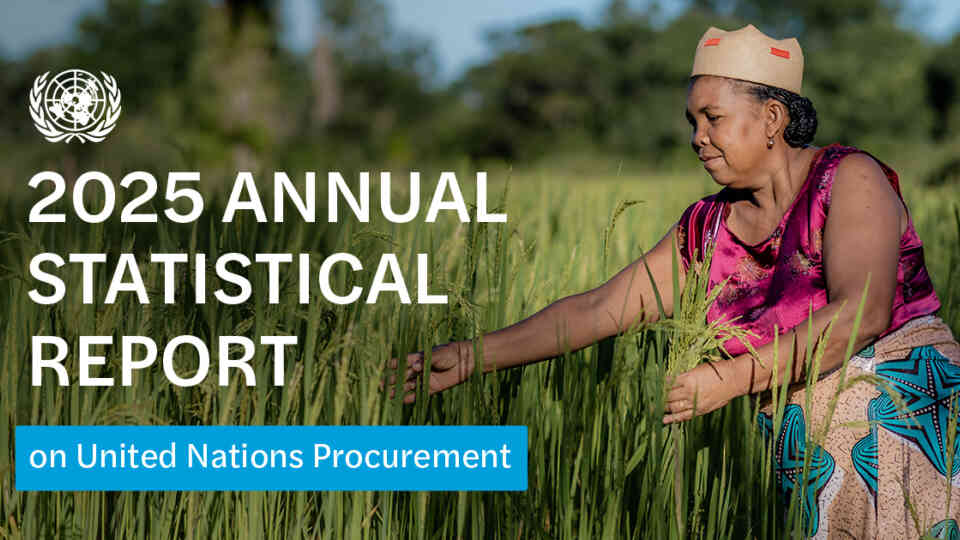
UN organizations spent $22.7 billion on goods and services in 2025, a decrease of 11.5 per cent since 2024.
The decrease reflects the UN's sustained liquidity crisis, record Member State arrears and the downsizing of several large peacekeeping missions.
The health sector remained the largest sector at $5.2 billion, accounting for nearly a quarter of all spending.
The 2025 Annual Statistical Report on UN Procurement analyzes the combined annual UN spending on goods and services.
It shows that 2025 marked the fifth highest annual total on record, remaining above pre-pandemic levels, even as procurement decreased by over 11 per cent compared with 2024. The decline reflects the UN's sustained liquidity crisis, record Member State arrears, and the downsizing of several large peacekeeping missions.
The health sector retained the largest share of the spending at $5.2 billion, accounting for nearly 23 per cent of all procurement costs. Pharmaceuticals, contraceptives and vaccines remained the largest procurement category for the UN at $4 billion.
Construction, engineering and science was the only sector to grow, reaching $3.6 billion on continued infrastructure demand. Food and farming saw the steepest decline, falling by one third to $1.6 billion.
Against a background of UN80 reforms for more streamlined and efficient efforts, collaborative procurement among UN organizations grew to nearly 8 per cent of all purchasing. Sustainable procurement also continued to advance across the system, with organizations expanding the tracking of supply chain emissions and further integrating social and economic considerations. 83 per cent of reporting organizations now embed sustainability criteria in their procurement.
“Procurement is at the heart of the UN's operations. It goes beyond an administrative function, and has immense potential to drive sustainability, create jobs, and promote inclusion and equity," said Jorge Moreira da Silva, UN Under-Secretary-General and UNOPS Executive Director.
"This report highlights how the UN system leverages its spending power to improve lives and deliver sustainable development in an increasingly complex world,” added Jorge Moreira da Silva.
In 2025, Europe overtook Asia as the largest supplier region, driven in part by sustained health-related purchasing. The United States remained the largest supplier at $2 billion. The UK ranked second due to record pharmaceutical sourcing, while Denmark came third.
UN procurement also continued to support development in some of the world's most vulnerable economies. Suppliers in least developed countries, landlocked developing countries and small island developing states together accounted for $5.3 billion of UN procurement in 2025 – nearly a quarter of the global total. In all, 227 countries and territories supplied goods and services to the UN in 2025. There was notable supplier growth in Sudan, State of Palestine, Uzbekistan and Brazil.
ENDS
Notes to the editors:
The full report will be available at: www.ungm.org/asr
Detailed statistics from the report can be explored through interactive dashboards available at: www.ungm.org/asr
For media inquiries please contact: communications@unops.org
About the Annual Statistical Report on United Nations Procurement (ASR)
The Annual Statistical Report on United Nations Procurement (ASR) provides an overview of the procurement of the United Nations (UN) system in support of its operations, projects and programmes. Introduced in 1984, it has been compiled and published by UNOPS since 2008 on behalf of the organizations of the UN system and in cooperation with the United Nations Global Marketplace (UNGM), where ASR data is published. (www.ungm.org/asr).
About UNOPS
UNOPS offers practical solutions across peace and security, humanitarian and development operations. We help the United Nations, governments and other partners to manage projects, and deliver sustainable infrastructure and procurement across the world. Read more: www.unops.org.