



The United Nations Office for Project Services (UNOPS)
Statement to UNOPS Client Board 2026 (UN segment)
Statement by Jorge Moreira da Silva, UN Under-Secretary-General and UNOPS Executive Director, to UNOPS Client Board 2026, Seventh Annual Meeting (UN segement)
[Check against delivery]
Dear Client Board members and observers,
We are living through perilous days. Our world is sliding into deeper conflict and climate disruptions.
The ceasefire announced last night is a welcome development - and I echo the SG’s call on the parties to comply with their obligations under international law and to respect the terms of the ceasefire - so we can move toward a lasting and comprehensive peace in the region.
That war has led to tremendous human suffering and global economic shock. As ever, civilians suffer the most, caught in conflicts not of their making.
Disruptions to airspace, transportation, shipping routes and humanitarian crossings are impacting humanitarian operations and supply chains, including the availability and prices of basic goods and pharmaceuticals. Developing countries in Asia and Africa are likely to bear the heaviest brunt.
We urgently need a durable settlement of this conflict. But we also need immediate action to mitigate the ripple effects of the disruptions to maritime trade through Hormuz.
I have been asked by the Secretary-General to lead a dedicated taskforce to address these challenges. We are working closely together with colleagues from the UN Conference on Trade and Development (UNCTAD), the International Maritime Organization (IMO), and the International Chamber of Commerce (ICC), and of course other entities as needed.
Our primary focus here is to develop technical mechanisms to meet humanitarian needs in the Strait of Hormuz. We will draw on lessons learnt from other relevant UN initiatives, including the Black Sea Grain Initiative (BSGI), the UN Verification, Inspection and Monitoring Mechanism for Yemen (UNVIM) and the UN2720 Mechanism for Gaza. The last two, as you know, are operationalized by UNOPS - in close collaboration with our partners and Member States.
****
Colleagues, this is a unique moment for the UN system.
Our world is facing the highest number of violent conflicts since the Second World War, with a quarter of the world’s population living in places affected by conflicts, from Gaza and Sudan to Ukraine, Haiti, Myanmar and Afghanistan. The recent escalation in the Middle East is adding to these numbers.
Meanwhile, the multilateral system itself is under unprecedented pressure.
For all of us at the United Nations, the imperative to come together, to find joint solutions and be more efficient and effective has never been more urgent, if not existential.
In this context - there is even more urgency to double down on our efforts to make UN80 a success.
UNOPS is fully committed to these efforts.
***
Around the world, UNOPS is focused on scaling up and speeding up practical solutions. Our teams deliver where it matters most – building, repairing and helping countries plan and deliver quality infrastructure, restoring essential services, strengthening public procurement systems, responding to climate change and supporting communities including in areas affected by crisis.
Our focus is on implementation: getting things done.
UNOPS serves as a key part of the UN system, providing critical technical, operational and logistical support across all pillars of UN work in peace and security, humanitarian action, and sustainable development. Through this support, we help translate UN resolutions and mandates into tangible, on-the-ground results for the communities we serve.
Our cooperation with other UN entities is extensive.
Last year, about 70 per cent of all of our work was in co-operation with other UN organizations. This includes delivering services for UN partners (around 20 per cent of our portfolio) and working with them on implementation and delivery of joint projects and programmes.
Allow me to share some examples.
In Gaza, our teams provide and distribute fuel for humanitarian purposes. They manage the UN 2720 Mechanism to accelerate and monitor the deliveries of humanitarian supplies, support access of humanitarian personnel, and mine action. Of course scaling up operations is contingent on unimpeded access currently controlled by the State of Israel, and we know that the recent escalation has had immediate consequences for Gaza, where access restrictions have disrupted supply lines again and constrained humanitarian operations.
In Yemen, on behalf of UN Member States and OCHA, UNOPS manages the UN Verification and Inspection Mechanism, with the goal of facilitating the flow of commercial goods and bilateral assistance into the war-ravaged country.
Elsewhere, UNOPS provides a range of essential operational services to UN missions, enabling leaner, more integrated operations to deliver their mandates efficiently and effectively.
In Ukraine, now entering the fifth year of the full-scale invasion, UNOPS continues to work closely with UN partners to sustain essential services under extreme conditions.
In one example, we are partnering with UNFPA to transform hospital basements into protected maternity units for women, newborns, and medical staff, including during ongoing attacks.
In Senegal, we support efforts to modernise the judicial system, working together with UNDP, UN Women and the International Telecommunication Union (ITU), to digitize court procedures and improve access, efficiency and transparency.
In Costa Rica, UNOPS is supporting the government in a national emergency response programme to rebuild damaged infrastructure and improve systems resilience – benefitting more than 2 million people. UNOPS provides advisory support to five government agencies with procurement, project management, and associated institutional strengthening, working alongside UN partners including UNFPA and the UN Office for Disaster Risk Reduction (UNDRR).
Alongside these, UNOPS enables the implementation of over a dozen multilateral initiatives, working across a range of areas in health and nutrition, climate and energy, and sustainable development across 130+ countries and territories.
One example is our work with ATscale - the Global Partnership for Assistive Technology. This is a multi-stakeholder, cross-sector partnership which aims to transform lives through accessible, affordable and quality assistive technology for people in low- and middle-income countries. It has been hosted by UNOPS for nearly five years now and works closely with partners including the World Health Organization, UNICEF, International Labour Organization, UNDRR, UN Women, and UNCTAD - to serve hundreds of millions in need across health, education, employment, gender, and climate sectors.
These examples reflect a broader portfolio of around 1,100 projects that UNOPS implements every year.
None of this would have been possible without your support and partnership. Thank you.
***
Colleagues,
Allow me to refer to the UN80 initiative.
UNOPS is actively engaged in efforts to make the UN more agile, integrated, and equipped to respond to increasingly complex global challenges amid tightening resources.
I have been involved in several aspects of this process, including co-ordinating on the reconfiguration of UN country teams. We have seen extensive interest in this process from across the UN. We anticipate being able to deliver a more impactful, strategic and streamlined UN country presence that draws on the relative strengths of all parts of the system.
We have also welcomed and are actively engaging in the ongoing assessment on the pros and cons of a merger between UNOPS and UNDP to create a new entity on sustainable development. This is a complex process, and we look forward to hearing views from all stakeholders.
UNOPS is no stranger to reforms. The agency has undertaken significant reforms in recent years to strengthen governance, accountability and performance, reinforcing our ability to deliver results.
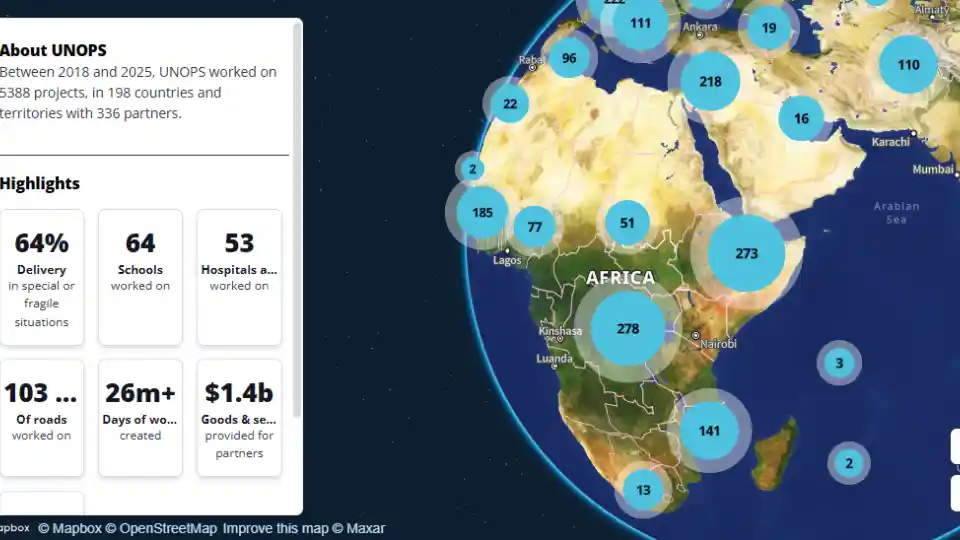
We believe that the UNOPS fee for service business model remains highly relevant. For over 30 years, we have worked with a wide range of partners - across the UN system, governments, intergovernmental, international and regional financial institutions, vertical funds, the private sector and NGOs. Two thirds of our work is in special or fragile contexts.
UNOPS provides services in exchange for the full cost recovery. It charges a minimal management fee to cover oversight and institutional costs at just over four per cent on average. This remains one of the lowest across the UN. Last year, UNOPS delivered $US 2.7 billion in over 130 countries with just 5,500 personnel.
Our partners clearly value this model.
A recent partner survey confirms strong confidence in UNOPS: 85 per cent of our partners reported satisfaction, 87 per cent described UNOPS as a trusted partner, and nearly 90 per cent valued the agility of the response.
Partners consistently highlight the professional teams, client-focused approach, and ability to deliver quality services including in challenging environments. In addition, partners see the cost-effectiveness and value-add of our services.
These results reflect the dedication of UNOPS personnel who work tirelessly to deliver impact for people and countries, including in the most dangerous contexts.
****
Distinguished representatives,
At a time when the value of multilateral cooperation is being questioned, our shared responsibility is to demonstrate that it works effectively and that it delivers results for people who need them most.
UNOPS stands ready to continue supporting our partners, and translating commitments into tangible impact for the people we serve.
In closing, I look forward to your perspectives and strengthening our cooperation.
Thank you.