


The United Nations Office for Project Services (UNOPS)
Statement to UNOPS Client Board 2026
Statement by Jorge Moreira da Silva, UN Under-Secretary-General and UNOPS Executive Director, to UNOPS Client Board 2026, Seventh Annual Meeting (General session)
[Check against delivery]
Distinguished members and observers,
We are living through perilous days. Our world is sliding into deeper conflict, instability and climate disruptions.
Our world is facing the highest number of violent conflicts since the Second World War, with a quarter of the world’s population living in places affected by conflicts.
Meanwhile, the multilateral system itself is under unprecedented pressure.
As ever, civilians suffer the most - older people, children and ordinary men and women, caught in conflicts not of their making.
The recent escalation in the Middle East builds on decades of conflict, deprivation and socio-economic stagnation with immense and endless suffering, grief and pain for people.
In the occupied Palestinian territory, UN figures showed that two years of war had erased over two decades of development progress.
Almost every person in Syria (or over 90 per cent) lives in poverty while one in four people are jobless.
In Lebanon and Iran, millions more face deepening poverty as renewed violence compounds already severe hardship.
I call once again for a cessation of violence and for peace to prevail in that part of the world for the sake of communities wherever they are.
Even as the world focuses on the Middle East, devastating crises continue in Sudan, Ukraine, Haiti, Myanmar or Afghanistan, and elsewhere.
There is no sustainable development without peace. And there is no peace without sustainable development.
The consequences of wars go far beyond national borders.
Disruptions to airspace and transportation corridors in the Middle East are already impacting humanitarian operations and commercial supply chains. This threatens the delivery of basic supplies, risks higher food prices, and further strains fragile health systems.
Against this background, UNOPS is focusing on scaling up and speeding up practical solutions. Our teams stay and deliver where it matters most – rebuilding and repairing civilian infrastructure, restoring essential services and supporting communities affected by crisis.
Our focus is on implementation: getting things done and fixed.
In short and as a United Nations organisation, serving people is at the heart of the UNOPS mandate. In an environment of mistrust towards the multilateral system, delivering tangible results is essential to rebuilding trust.
Allow me to share some recent examples of our work.
In Gaza, our teams continue to provide and distribute fuel for humanitarian purposes. The team manages the UN 2720 Mechanism to accelerate and monitor the deliveries of humanitarian supplies, supporting access of humanitarian personnel, and mine action. Scaling up operations is contingent on unimpeded access currently controlled by the State of Israel.
The recent escalation has had immediate consequences for Gaza, where access restrictions have disrupted supply lines again and constrained humanitarian operations. After days of closures to crossings, UNOPS was able to take in fuel via Karem Abu Salem/Kerem Shalom crossing on 3 March. Other crossings meanwhile, including Rafah, remain closed impacting medical evacuations and humanitarian operations.
Our teams continue to operate under extremely dangerous conditions. Recently, a UNOPS fuel truck inside Gaza was struck from the direction of the sea. While no one was injured, the incident underscores the risks faced daily by humanitarian workers. I have called for a full investigation into this latest incident.
Beyond the Middle East, UNOPS continues to support communities in crisis and recovery.
The world recently marked four years of the full-scale invasion of Ukraine. Intensified attacks on civilian infrastructure continue to disrupt electricity, water and heating during the harsh winter. These have affected civilians including those far from the frontline - among them older people and children.
UNOPS continues to work with partners to support the restoration of services. Over the past four years, the teams helped keep people and their homes and work places warm through generators and improved infrastructure. Over the past year alone, UNOPS delivered over $45 million worth of heating equipment, helping municipalities restore essential services for hundreds of thousands of families.
Working closely with our partners, our teams have procured health supplies, they repaired damaged and destroyed schools, and refurbished damaged homes.
In Myanmar, we work with partners to improve health, livelihoods, rural development and agriculture. UNOPS manages some of the largest development projects in livelihoods, health and food security. For example, UNOPS is the Principal Recipient for the Global Fund to Fight AIDS, Tuberculosis and Malaria (Global Fund) in Myanmar. My colleagues also support humanitarian efforts to reduce the risk posed by mines.
In South Sudan, UNOPS is working with the government to strengthen institutional capacity and foster economic inclusion for women and girls. This work - financed by the World Bank - includes building women’s community centres,a safe house and new headquarters for the Ministry of Gender, Child and Social Welfare in Juba.
In Haiti, we are working with the government to strengthen food security, in a project financed by the World Bank. This work addresses the root causes of hunger and malnutrition, by strengthening water infrastructure, rehabilitating roads and improving market access, helping crop producers boost production, and improving access to water and energy supplies.
And in Türkiye, UNOPS is working with the government, UN Women and the EU to help build safe spaces where women and children can find refuge, support and services, in areas affected by the 2023 earthquakes.
Alongside these, our focus continues on offering practical solutions to drive climate action globally. Our work spans efforts to plan and build sustainable and resilient infrastructure, conduct and promote sustainable procurement and operate multi-stakeholder initiatives to drive climate action, such as Sustainable Energy for All (SE4All) or the Santiago Network.
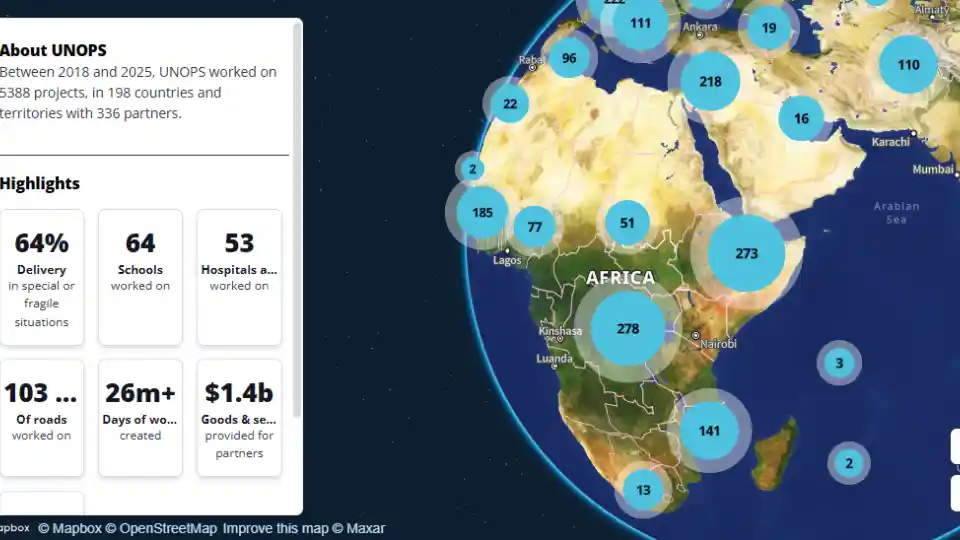
Overall, UNOPS enables the implementation of over a dozen multilateral initiatives, working across a range of areas in health and nutrition, climate and energy, and sustainable development across 130+ countries and territories.
Needless to say that all of this great work would not have been possible without the support, generosity and commitment of all of you - our partners.
Thank you.
***
Distinguished representatives,
Allow me to refer to the UN80 initiative.
With my colleagues at UNOPS, we have been actively engaged in efforts to make the UN more agile, integrated, and equipped to respond to increasingly complex global challenges amid tightening resources.
I have been involved in several aspects of this process, including on the reconfigurations of UN country teams.
As part of this broader review, UNOPS has welcomed an ongoing assessment on the pros and cons of a merger between UNOPS and UNDP to create an entity on sustainable development.
UNOPS is no stranger to reforms. Over the past three years, the agency has completed a comprehensive set of reforms to strengthen governance, accountability and organisational resilience. This included reinforced risk management and internal controls, clearer lines of responsibility and oversight, strengthened ethics and compliance functions, and a renewed focus on organisational culture. UNOPS has -in parallel- advanced reforms in planning, performance management and transparency, embedding a stronger results-based and impact-oriented approach aligned with the operational mandate.
We believe that the UNOPS fee for service business model remains highly relevant. For over 30 years, we have worked with a wide range of partners - across the UN system, governments, intergovernmental, international and regional financial institutions, vertical funds, the private sector and NGOs. Two thirds of our work is in special or fragile contexts.
UNOPS provides services in exchange for the full cost recovery. It charges a minimal management fee to cover oversight and institutional costs at just over four per cent on average. This remains one of the lowest across the UN. Last year, UNOPS delivered $US 2.7 billion in over 130 countries with just 5,500 personnel.
Our partners clearly value this effective model.
A recent partner survey confirms strong confidence in UNOPS: 85 percent of our partners reported satisfaction, 87 per cent described UNOPS as a trusted partner, and nearly 90 percent valued the agility of the response.
Partners consistently highlight the professional teams, client-focused approach, and ability to deliver quality services including in challenging environments. In addition, partners see the cost-effectiveness and value-add of our services.
These results reflect the dedication of UNOPS personnel who work tirelessly to deliver impact for people and countries, including in the most dangerous contexts.
In these challenging times, UNOPS and its business model can be more relevant than ever to help in efficiency, effectiveness and delivery of results.
****
Distinguished representatives,
At a time when the value of multilateral cooperation is being questioned, our shared responsibility is to demonstrate that it works effectively and that it delivers results for people who need them most.
UNOPS stands ready to continue supporting our partners, and translating commitments into tangible impact for the people we serve.
In closing, I look forward to your perspectives and strengthening our cooperation.
Thank you.